
Extra (optional) exercises – Short Day#
These exercises are optional extra material for students who have finished the exercises of the day and have the time and interest for more.
Extra exercise 1: Area under a parabola#
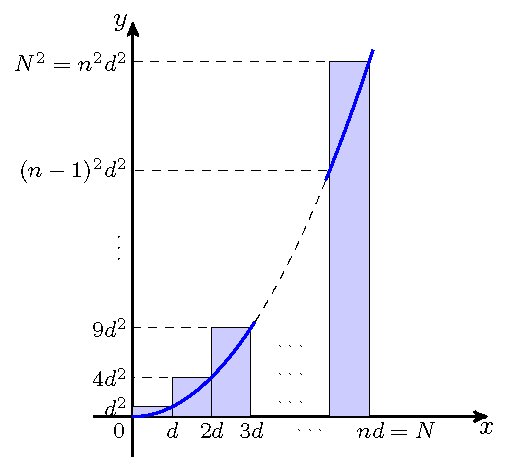
Let \(N\) be a positive real number and \(n\) a natural number. We define \(d=N/n\). As is most likely known from highschool, the area between the parabola and the first axis between \(x=0\) and \(x=N\) can be computed as a definite integral as follows:
In this exercise we wish to investigate how well this area is approximated using the finite sum \(\sum_{k=1}^n d\cdot(kd)^2\). The situation is illustrated in the following figure:
Question a#
Use the figure above to realise that
Question b#
The following distributive rule holds true for all natural numbers \(n\) and all complex numbers \(a,b_1,\dots,b_n\):
Use this fact to realise that
Question c#
Use induction on \(n\) to realise that \(\sum_{k=1}^n k^2=\frac13 n(n+1/2)(n+1)\) for all natural numbers \(n\).
Hint
In the induction step you will most likely at some point get to the formula
You could expand this expression by multiplying through and then check that it gives the correct result, but a lot of work can be saved by first factorizing \(n\) outside of the brackets:
Now try to realise that the expressions in the parentheses equal \(\frac13 (n+1/2)(n+1).\)
Answer
For the base case, when \(n=1\), the formula holds since \(\sum_{k=1}^1 k^2=1^2=1\) agrees with \(\frac13 1(1+1/2)(1+1)=\frac{3}{3}=1\).
For the induction step, when \(n \ge 2\), if we assume the induction hypothesis which says that \(\sum_{k=1}^{n-1} k^2=\frac13 (n-1)(n-1/2)n\), we get
For example, by following the above hint it should be possible to realise that \(\frac13 (n-1)(n-1/2)n+n^2=\frac13 n(n+1/2)(n+1)\), which means that the induction step holds. The induction principle hence implies that the formula \(\sum_{k=1}^n k^2=\frac13 n(n+1/2)(n+1)\) holds for all natural numbers \(n\).
Question d#
Now show that \(\sum_{k=1}^n d\cdot (kd)^2=\frac{1}{3}N(N+d/2)(N+d)\).
Answer
From the previous question we have
For the last equal sign we used the fact that \(N=dn\).
Note that this equation implies that if \(N\) is held fixed while \(n\) goes towards infinity, then \(d\) goes towards zero, and the sum hence goes towards \(\frac13 N^3,\) which precisely is the area under the parabola.